
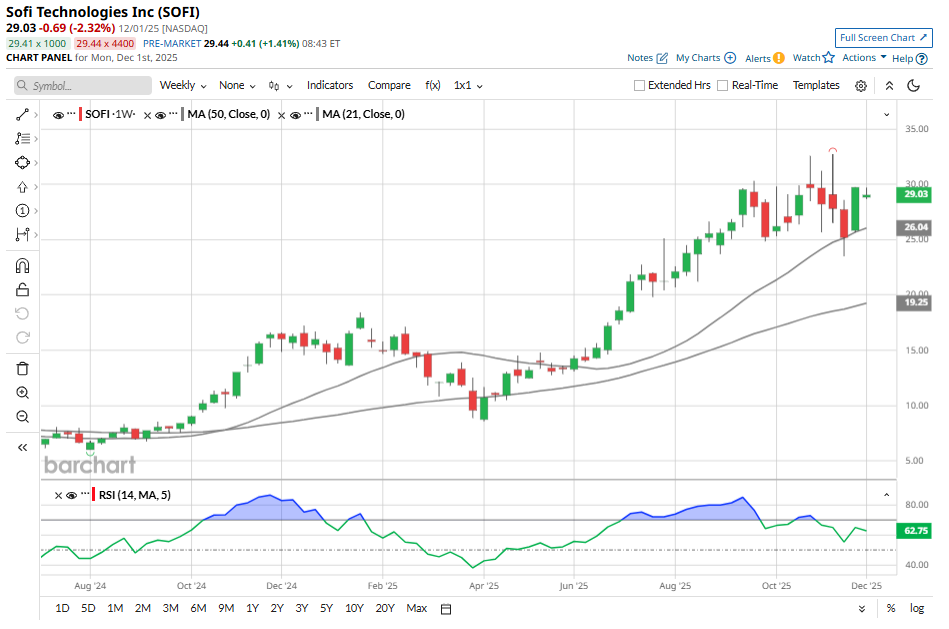
Shares of SoFi Technologies (SOFI) have climbed more than 118% over the past six months. Behind this surge are the company’s consistently solid financial performances over the past several quarters. The fintech is attracting new members at a rapid pace and expanding the number of financial products customers use. This, in turn, is driving its financials and share price.
Adding to the positives is SoFi’s focus on revenue diversification. The company is moving toward more capital-light revenue streams, such as technology platform fees and financial services income. These areas lower the dependency on interest income and reduce credit risk. At the same time, SoFi’s lending division remains healthy thanks to solid loan originations and its strong deposit base, which keeps its funding costs lower.
But with this steep rally, SoFi stock currently trades above the average analyst price target of $27, hinting that expectations may already be high. Looking ahead to 2026, year-over-year comparisons will become tougher after several quarters of explosive growth, making it harder for SoFi to maintain the same level of momentum. If growth moderates, the upside could be more limited from here.
Is SoFi Set to Deliver Strong Growth?
SoFi Technologies has evolved into a diversified financial services platform with multiple growth catalysts. While recent share price appreciation warrants caution around valuation, SoFi’s fundamentals remain solid. The growing scale of its platform, the improvement in the quality of its revenue mix, and its solid funding structure provide a strong base for sustained growth.
SoFi’s record pace of member acquisition reflects the appeal of its all-in-one digital financial platform. With 905,000 new members added in the most recent quarter, membership increased 35% year-over-year to 12.6 million. Product additions climbed 36% year-over-year to 18.6 million, and approximately 40% of new products came from existing members, the strongest cross-buy rate in over two years. SoFi’s increasing product density drives up lifetime revenue per member and lowers customer acquisition costs.
Notably, SoFi’s Financial Services and Technology Platform businesses, its capital-light engines, delivered $534 million in revenue in Q3, up 57% and surpassing half a billion in quarterly revenue for the first time.
Further, SoFi’s fee-based revenue, a critical indicator of SoFi’s shift beyond lending, reached $409 million, a 50% jump, and now exceeds $1.6 billion in annual run rate. This evolution toward recurring, less variable income should meaningfully improve profitability and reduce sensitivity to interest rate cycles.
One of the top growth catalysts for SoFi has been its Loan Platform Business (LPB), which enables SoFi to originate and transfer customized loan portfolios for third-party partners. Because these loans pass through SoFi's balance sheet only briefly and without retention of credit risk, the business generates fee income without tying up capital. This approach boosts revenue and strengthens the balance sheet.
Although SoFi is focusing on diversifying its revenue base toward fee-based, capital-light businesses, its lending business remains a strong contributor to its financials. The segment recorded 23% revenue growth in Q3 to $481 million. Loan originations hit an all-time high of $9.9 billion, driven by demand for unsecured personal loans. Meanwhile, deposits climbed to $32.9 billion. This lowers SoFi’s funding costs versus traditional loan securitization.
In summary, SoFi is expected to deliver solid growth, led by a rapidly expanding member base, accelerating penetration of fee-based, capital-light businesses, and a strong deposit base.
Conclusion: Is SoFi Stock a Buy, Sell, or Hold?
SoFi has executed impressively on both growth and diversification, building a scalable financial platform with improved profitability drivers and a more resilient revenue mix. SoFi's accelerating member growth, rising product adoption, and traction in fee-based businesses point to solid long-term growth. Additionally, its strong deposit base continues to support lending economics.
However, after a triple-digit gain in just six months, much of this optimism appears priced into the stock. Trading above consensus targets, SoFi now faces a higher bar to justify further upside, especially as year-over-year comparisons become more challenging.
Given the recent run, Wall Street maintains a “Hold” consensus rating on SoFi stock, suggesting investors should wait for a pullback and look for a more favorable entry point.

On the date of publication, Amit Singh did not have (either directly or indirectly) positions in any of the securities mentioned in this article. All information and data in this article is solely for informational purposes. For more information please view the Barchart Disclosure Policy here.
More news from Barchart
- Analysts Say AWS Will Drive ‘Significant Upside’ for Amazon. Should You Buy AMZN Stock Now?
- This Analyst Predicts Tesla Stock Will Crush Traditional Automakers, ‘They Had Plenty of Warning Time’
- Top 100 Stocks to Buy: Par Pacific Holdings Looks Tempting, But Should You Bite?
- How Should You Play NVDA Stock Amid Reports That China Banned ByteDance from Using Nvidia GPUs?