
Johannesburg, South Africa - The integration of artificial intelligence into enterprise SEO is accelerating a shift that many large, multi-location brands are only beginning to fully understand. While AI-driven tools promise efficiency and scale in competitor analysis, they are also introducing new layers of complexity that demand careful oversight.
For organizations operating across multiple regions, competitor analysis has historically been resource-intensive and difficult to standardize. Each location presents its own set of variables, including local search behavior, language nuances, and differing competitive landscapes. As a result, strategies that perform well in one market often fail to translate effectively into another, requiring constant adjustment and localized insight.
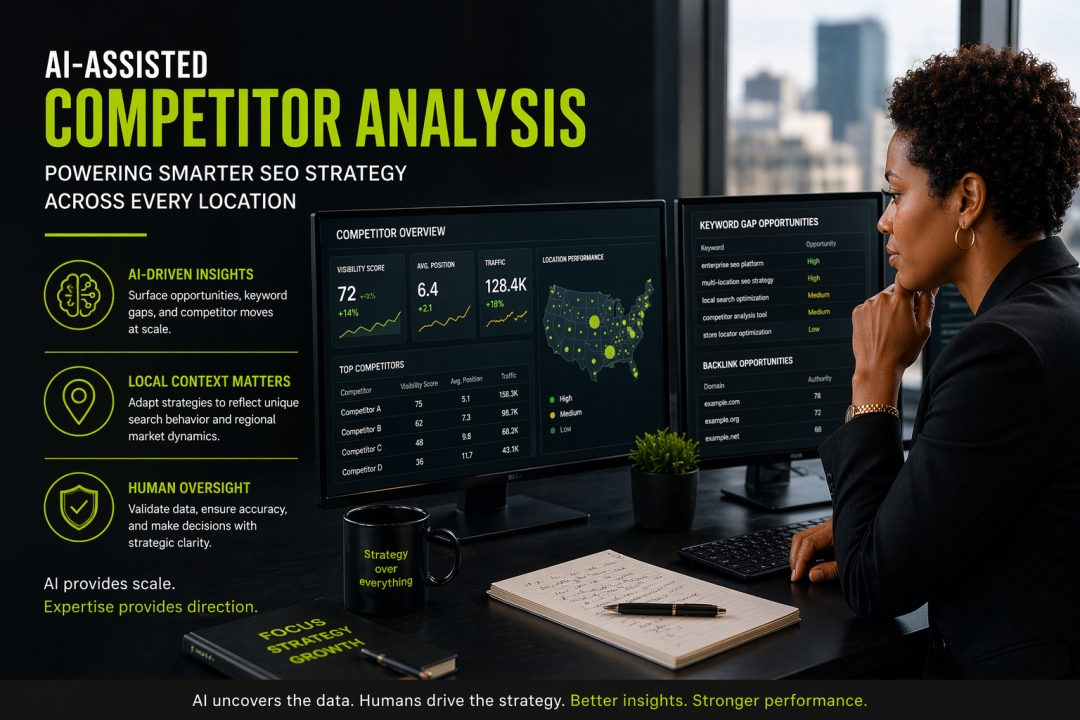
AI tools are now positioned as a solution to this challenge. By processing vast amounts of data at speed, these systems can identify keyword gaps, uncover backlink opportunities, and map competitor strategies across multiple locations simultaneously. This capability allows enterprise teams to move faster, respond more dynamically, and manage scale in a way that was previously unattainable.
However, the increasing reliance on AI introduces a critical tension between speed and accuracy.
Not all AI-generated insights are grounded in reliable or complete data. In many cases, outputs are influenced by partial datasets, inferred relationships, or synthetic modeling that may not accurately reflect real-world conditions. When these insights are accepted without validation, the result is not improved performance but misaligned strategy. At an enterprise level, even small inaccuracies can scale quickly, affecting multiple markets and compounding inefficiencies.
To address this, leading SEO teams are adopting structured frameworks that prioritize both scalability and governance.
The first principle within these frameworks is data source validation. Organizations must ensure that the data informing AI outputs is derived from credible, real-world signals rather than approximations. Without this foundation, the reliability of any insight becomes questionable, regardless of how advanced the tool may appear.
The second principle is contextual calibration. Multi-location brands operate within diverse and dynamic environments, and AI outputs must be adapted to reflect these differences. Search intent, cultural context, and competitive behavior vary significantly between regions, and applying uniform strategies across all locations can lead to underperformance or missed opportunities.
The third principle is the establishment of governance through human oversight. While AI can identify patterns and surface opportunities, it lacks the contextual understanding required for strategic decision-making. Enterprise teams are increasingly embedding review checkpoints into their workflows, where experienced SEO professionals assess, refine, and validate AI-generated recommendations before implementation.
This approach reflects a broader shift in how AI is being positioned within digital strategy. Rather than serving as a replacement for expertise, AI is being integrated as a decision-support tool that enhances, rather than overrides, human judgment.
For US-based and global multi-location enterprises, this distinction is particularly important. The scale at which these organizations operate means that errors are not isolated. A flawed insight, if deployed across multiple regions, can result in significant losses of time, budget, and competitive positioning.
As the role of AI in SEO continues to expand, the emphasis is moving away from adoption alone and toward responsible integration. The organizations that are most likely to succeed are those that recognize the value of AI while maintaining strong governance structures that ensure accuracy, relevance, and strategic alignment.
The evolution of competitor analysis is not defined by the tools being used, but by how those tools are applied. In an environment where data is abundant but not always reliable, the ability to balance scale with scrutiny will determine whether AI becomes a strategic advantage or a source of risk.
Media Contact
Company Name: Katina Ndlovu
Contact Person: Katina Ndlovu
Email: Send Email
Phone: +27638634882
City: Sandton
State: Gauteng
Country: South Africa
Website: https://katinandlovu.biz/