
Hangzhou, Zhejiang, China - September 11, 2026
Choosing between an automatic coffee packaging machine and a semi automatic packing machine is rarely a simple question of speed.
For a coffee manufacturer producing one or two high-volume SKUs every day, automation can reduce labor requirements and improve consistency. For a growing roaster running multiple package sizes, seasonal products, and smaller private-label orders, a semi-automatic system may offer better flexibility and lower financial risk.
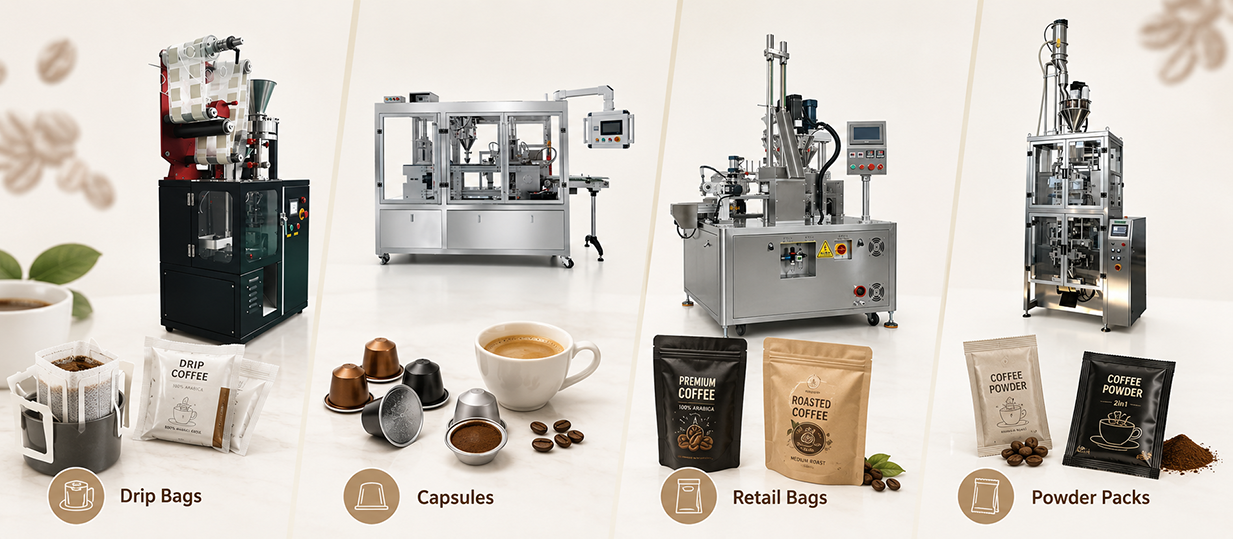
The right decision depends on the actual product. Whole beans, ground coffee, drip coffee bags, coffee capsules, instant coffee powder, and bag-in-bag formats all require different feeding and packaging processes.
Production volume matters too, but it should not be considered in isolation. Buyers also need to evaluate operator skill, packaging material, filling accuracy, changeover frequency, available floor space, after-sales support, spare parts, compressed air, electrical requirements, and future growth.
This guide compares automatic and semi-automatic coffee packing equipment from a B2B purchasing perspective, with a focus on real manufacturing conditions rather than headline machine specifications.
Quick Comparison Table
|
Factor |
Automatic Coffee Packaging Machine |
Semi-Automatic Packing Machine |
|
Production Speed |
High |
Low to medium |
|
Labor Requirement |
Lower per unit produced |
Higher operator involvement |
|
Initial Investment |
Higher |
Lower |
|
Changeover Flexibility |
Depends on machine design |
Often higher for short runs |
|
Consistency |
High when properly configured |
More dependent on operator |
|
Maintenance Complexity |
Higher |
Lower to moderate |
|
Best Fit |
Stable, recurring commercial production |
Smaller runs, flexible production, early-stage growth |
What Is an Automatic Coffee Packaging Machine?
An automatic coffee packaging machine performs most of the packaging cycle with limited manual intervention.
Depending on the configuration, one line may automatically handle:
- · Coffee feeding
- · Dosing or weighing
- · Film unwinding
- · Bag forming
- · Filling
- · Nitrogen flushing
- · Heat sealing
- · Cutting
- · Date or batch coding
- · Counting and finished-product discharge
Specialized systems may go further. A fully automatic drip coffee bag line can form the inner filter, dose the ground coffee, seal the filter, transfer it into an outer pouch, flush with nitrogen, and seal the final sachet.
Automatic capsule equipment can feed empty capsules, fill coffee, place lids, seal, inspect, and discharge the finished units.
The advantage is continuous production. Once materials, settings, and recipes are stable, operators mainly monitor the machine, replenish materials, perform quality checks, and respond to alarms or changeovers.
What Is a Semi-Automatic Packing Machine?
A semi automatic packing machine automates selected production steps while leaving others to an operator.
For example, the machine may automatically weigh and fill coffee, while an employee manually places the pouch and removes the finished pack. Another system may fill pre-made bags but require manual feeding before sealing.
Semi-automatic equipment is especially common among small and medium-sized roasters, product-development teams, contract packers handling many short runs, and businesses moving away from completely manual production.
The lower investment is attractive, but flexibility can be just as valuable. A factory producing 250 g retail bags in the morning, 1 kg wholesale bags in the afternoon, and a small private-label order the next day may not need the complexity of a fully integrated automatic line.
Key Differences Between Automatic and Semi-Automatic Systems
|
Area |
Automatic |
Semi-Automatic |
Purchasing Impact |
|
Workflow |
Integrated continuous process |
Mix of machine and manual operations |
Affects labor planning |
|
Output |
Higher |
Moderate |
Determines scale potential |
|
Operator Dependency |
Lower during normal running |
Higher |
Influences labor cost and consistency |
|
Technical Complexity |
Higher |
Lower |
Changes maintenance requirements |
|
Changeovers |
Can require tooling and setup time |
Often easier for small batches |
Important for multi-SKU production |
|
Capital Risk |
Higher |
Lower |
Important when demand is uncertain |
Advantages of Automatic Coffee Packaging Machines
Higher Production Capacity
The main advantage is output. Automated feeding, dosing, forming, filling, and sealing allow production to continue without an operator manually handling every package.
This becomes valuable when a product reaches stable commercial volume. A small difference in cycle time multiplied across several shifts can significantly affect monthly capacity.
More Consistent Filling
Automated dosing systems reduce variation caused by manual handling. This matters because overfilling quickly becomes expensive.
If a factory unintentionally overfills a 10 g drip coffee bag by 0.3 g, one million units represent around 300 kg of additional coffee.
Lower Labor Cost per Unit
An automatic line still requires trained employees, but fewer people are needed for repetitive filling, sealing, and transfer operations.
The labor advantage becomes more significant in markets with higher wage costs or where skilled production workers are difficult to recruit.
Better Process Integration
Automatic systems can combine coding, nitrogen flushing, checkweighing, counting, conveyors, and inspection into one line. This reduces manual transfer between production steps.
Scalable Production
For manufacturers supplying supermarkets, large restaurant groups, distributors, or recurring private-label programs, an automatic line creates a clearer path toward higher output.
Advantages of Semi-Automatic Packing Machines
Lower Initial Investment
A semi-automatic system is usually less expensive because it contains fewer integrated feeding, transfer, inspection, and control systems.
This can make it more practical for growing roasters or manufacturers testing a new product category.
Better Fit for Short Runs
Buyers producing frequent small orders may lose more time changing a fully automatic line than they gain from its maximum speed.
Semi-automatic production can be particularly efficient when different customers use different bag sizes, coffee weights, or packaging materials.
Simpler Maintenance
Fewer mechanisms normally mean fewer components requiring adjustment, synchronization, or replacement.
Lower Production Risk During Market Testing
A brand launching a new single-serve format may not know whether demand will reach hundreds of thousands of units per month. A lower-cost machine limits capital exposure until sales are proven.
Performance Comparison
Machine performance should be evaluated at normal production conditions, not only during a slow factory demonstration.
Production Speed
Automatic equipment clearly leads when long production runs are involved. The practical advantage is less pronounced when products change frequently or packaging material requires repeated setup.
Filling Accuracy
Both machine types can achieve good accuracy if the dosing system is correctly selected.
Ground coffee may use auger or volumetric dosing. Whole beans are often suited to weighing systems. Fine instant coffee powder may behave differently again.
Buyers should therefore compare dosing technology rather than assuming every automatic machine is inherently more accurate.
Seal Quality
Seal quality depends on packaging material, temperature, dwell time, pressure, and whether coffee contaminates the sealing area.
Automation can produce very consistent seals, but only when the film and machine are correctly matched.
Changeover Efficiency
This is where semi-automatic equipment can perform surprisingly well.
A co-packer producing ten different customer designs may care more about a 20-minute changeover than a higher theoretical bags-per-minute rating.
At Tonchant, machinery discussions often begin with the buyer’s SKU structure for this reason: a high-speed machine is useful only if the production schedule allows it to run efficiently.
Cost Comparison
Purchase price is only one part of the machine’s economics.
Buyers should calculate total ownership cost using:
Machine purchase price
Tooling
Installation
Freight and import costs
Operator labor
Electrical consumption
Compressed air
Nitrogen where applicable
Maintenance
Spare parts
Packaging waste
Production downtime
Training
An automatic machine usually requires more capital but may lower labor cost per unit. A semi-automatic machine has a lower entry cost but may become expensive if growing volume requires several operators or multiple shifts.
Practical Cost QuestionInstead of asking, “Which machine is cheaper?” calculate the cost per thousand finished packs at your expected annual volume.
A business producing 20,000 packs per month can reach a different conclusion from one producing two million.
Environmental Impact Comparison
Machinery is rarely the largest environmental factor in a coffee packaging project, but equipment selection still affects energy use, waste, and production efficiency.
An automatic line may consume more electricity during operation because it contains additional motors, heaters, conveyors, pumps, sensors, and control systems.
At the same time, high-speed automation can reduce product giveaway and packaging waste when correctly configured.
Semi-automatic equipment may consume less energy per hour, but manual handling can create more variation in filling, seals, or rejected packaging depending on the process.
Buyers should therefore evaluate:
Energy consumption per finished unit
Film waste during startup
Reject rates
Coffee overfill
Compressed-air consumption
Machine service life
Compatibility with recyclable or alternative packaging materials
Sustainable packaging materials also need machine trials. Paper-based, mono-material, or other alternative films can have different stiffness, friction, and sealing windows than conventional laminates.
Applications Comparison
|
Application |
Automatic |
Semi-Automatic |
Recommendation |
|
High-Volume Drip Coffee |
Excellent fit |
Limited at scale |
Automatic usually preferred |
|
Coffee Capsules |
Strong fit for recurring volume |
Useful for development or small batches |
Depends on volume |
|
Private-Label Co-Packing |
Good for stable SKUs |
Very flexible |
Consider changeover frequency |
|
Whole Bean Retail Bags |
Suitable for large production |
Excellent for smaller roasters |
Both are common |
|
Instant Coffee Powder |
Excellent at scale |
Suitable for small programs |
Check powder flow behavior |
|
Startup / Market Test |
Often excessive |
Strong fit |
Semi-automatic often reduces risk |
Pros and Cons Summary
Automatic Coffee Packaging Machine
Pros
High production capacity
Lower labor requirement per unit
Consistent filling and sealing
Integration with coding and inspection
Strong scalability
Cons
Higher investment
More complex maintenance
May require trained technicians
Changeovers can take longer
Greater financial risk if demand is uncertain
Semi-Automatic Packing Machine
Pros
Lower entry cost
Flexible for short runs
Simpler maintenance
Useful for multiple SKUs
Good transition from manual production
Cons
Higher labor dependency
Lower total output
More operator variation
Can become inefficient at high volume
More manual product handling
Which One Is Better?
There is no universal winner.
An automatic coffee packaging machine is generally the stronger option when production volume is high, SKU changes are limited, labor cost is significant, and demand is predictable.
A semi-automatic system often makes more sense when production volumes are smaller, product formats change frequently, capital budgets are limited, or the business is still validating demand.
Consider two examples.
A manufacturer supplying one national customer with 500,000 identical drip coffee bags every month is likely to benefit from automation.
A co-packer handling 15 boutique coffee brands, each ordering relatively small batches with different packaging, may gain more value from flexible semi-automatic equipment.
Speed matters only when there is enough stable production to use it.
How Buyers Should Choose
1. Define the Finished Product
Start with the coffee format: beans, powder, drip bags, capsules, round filters, or another structure.
Machine selection should follow the product—not the other way around.
2. Calculate Real Required Capacity
Estimate monthly output based on actual orders and realistic growth rather than optimistic forecasts.
Include machine downtime, cleaning, changeovers, material loading, quality checks, and maintenance.
3. Review SKU Complexity
A plant producing one bag size continuously has different needs from a contract packer switching between five filling weights and several pouch dimensions.
4. Send Real Packaging Materials for Testing
Film thickness, stiffness, surface friction, sealing layer, and roll dimensions can affect machine behavior.
Test the actual coffee and final packaging whenever possible.
5. Evaluate Factory Utilities
Confirm voltage, frequency, compressed air, nitrogen supply, drainage where applicable, available floor space, and environmental conditions.
6. Review Safety and Documentation
Depending on the destination market and equipment, buyers may need to review:
CE documentation where applicable
Electrical drawings
Machine safety documentation
Emergency-stop systems
Safety guarding
Food-contact declarations for relevant contact components
Operating manuals
Do not rely only on a certificate label. Request documentation for the actual machine model being purchased.
7. Check After-Sales Support
Ask how troubleshooting works after installation.
Important questions include:
Which spare parts should be stocked locally?
Are manuals available in English?
Is remote technical support available?
How quickly can replacement components be shipped?
Does the supplier provide installation or operator training?
8. Perform a Real Factory Trial
At Tonchant, we consider sample running more useful than comparing brochures alone. A realistic trial should check output, filling tolerance, seals, waste, product appearance, alarms, changeover time, and operator usability.
The goal is not to prove that the machine can run. It is to determine whether it can run your product repeatedly under commercial conditions.
Common Buyer Concerns
Will an automatic machine reduce headcount?
It can reduce repetitive manual work, but operators are still required for material supply, quality control, machine supervision, cleaning, maintenance, and secondary packing.
Can one machine handle several coffee formats?
Some size changes are possible through tooling and recipe adjustments, but very different formats may require completely different machinery. A capsule machine, drip bag machine, and whole-bean pouch machine are not interchangeable.
Is the highest-speed machine always the best value?
No. If upstream coffee supply, downstream carton packing, or frequent changeovers prevent the line from operating at full speed, the additional capacity provides little value.
What if production grows later?
Buyers should discuss expansion options before purchase. Some factories begin with semi-automatic filling and later add conveyors, automatic feeders, checkweighers, or secondary packaging.
How important are spare parts?
Very important. A low-cost machine becomes expensive if a small failed component stops production for several weeks.Conclusion
Choosing between an automatic coffee packaging machine and a semi automatic packing machine should begin with production reality rather than maximum machine speed.
Fully automatic equipment offers clear advantages in output, repeatability, process integration, and labor efficiency. It is usually the better fit for manufacturers with stable, recurring commercial volume.
Semi-automatic machinery offers lower investment, simpler maintenance, and valuable flexibility. For smaller roasters, new product programs, and contract packers handling frequent SKU changes, those advantages can outweigh the difference in speed.
Procurement teams should compare total ownership cost, not purchase price alone. Include labor, tooling, maintenance, utilities, spare parts, packaging waste, changeovers, downtime, and expected machine utilization.
The right coffee packaging machine is ultimately the one that can produce the required package consistently, at the required volume and quality, without creating unnecessary cost or complexity for the factory.
About Us
Tonchant® is started in 2007, growing up while producing various food packing bags, boxes, and packing tapes, due to excellent quality and service, Tonchant expanded their oversea market rapidly-annual revenue reached US$50 Million.
Media Contact
Company Name: SHANGHAI TONCHANT PACKAGING MATERIAL CO., LTD.
Contact Person: Media Relations
Email: Send Email
Country: China
Website: https://www.coffeeteabag.com/