
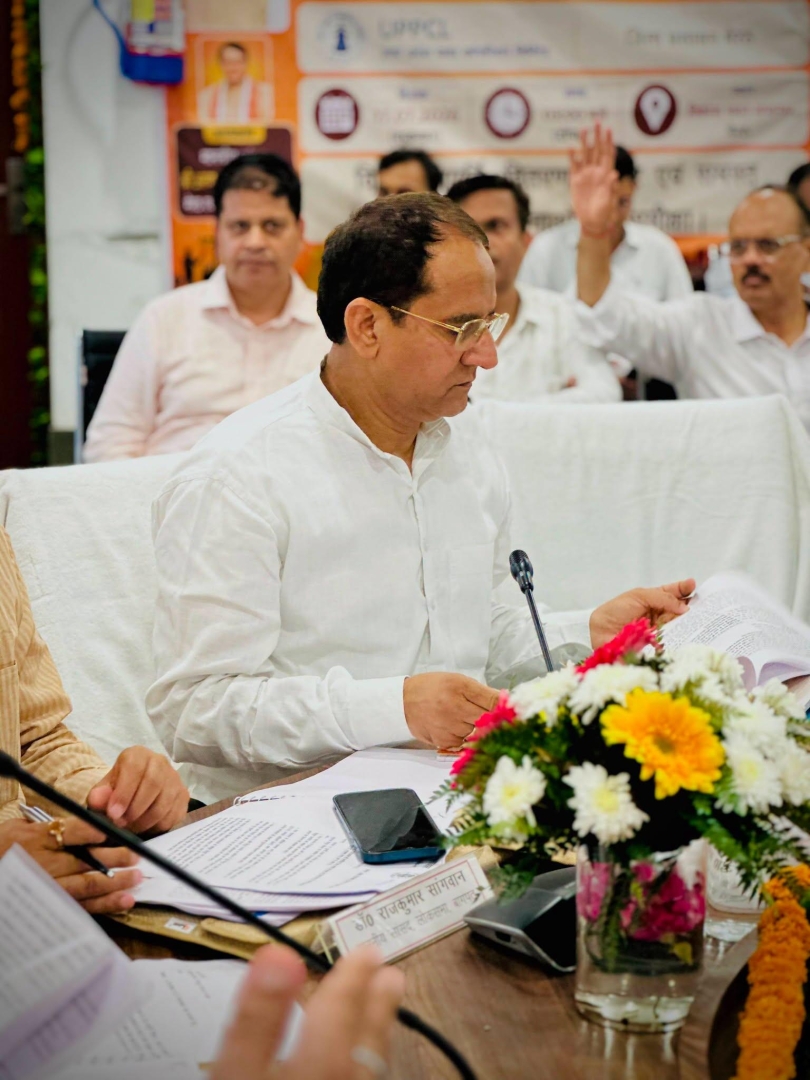
MEERUT, UTTAR PRADESH, INDIA - 5 September, 2026 - Marking Teachers' Day, MLC Dharmendra Kumar Bhardwaj, Member of the Uttar Pradesh Legislative Council from the Meerut-Ghaziabad Local Authorities constituency, announced a Teacher Assistance and Grievance Support Service through his public office — to help educators document problems, identify the correct authority and follow the status of representations relating to honorarium payments, welfare benefits, service issues and access to existing government schemes.
The service is designed for teachers and education workers who often know that a problem exists but do not know which office should receive it, what document is missing or whether a representation has moved after submission. The constituency office will record the issue, provide a dated acknowledgement, identify the competent department where possible, forward the representation through the appropriate channel and maintain a follow-up record. It will not decide transfers, release salaries, approve medical claims, alter service records or sanction government benefits — those powers remain with the competent authorities — and it will not collect money in the name of teacher welfare.
The announcement comes in a year in which the Uttar Pradesh Government approved a major increase in honorarium for Shiksha Mitras and part-time instructors. In April 2026, the State approved an increase in the monthly honorarium of Shiksha Mitras from Rs 10,000 to Rs 18,000 and of part-time instructors from Rs 9,000 to Rs 17,000, applicable from April 2026. Dharmendra Bhardwaj MLC said the immediate public-service need is to help affected workers flag payment delays, documentation difficulties or other implementation problems where they arise — without claiming credit for a decision taken by the State Government.
"A teacher who comes with a genuine problem should not be sent from one desk to another without even knowing where the matter stands. My office cannot replace the department, but it can make sure the representation is properly recorded, sent to the right place and followed up," said MLC Dharmendra Kumar Bhardwaj.
"Teachers' Day should not end when the flowers are removed from the stage. The next morning, the unresolved salary, medical, service or documentation problem is still there. That is where public service has to begin."
The assistance service will accept matters from government teachers, aided-sector teachers, Shiksha Mitras, part-time instructors, contractual educators and other teaching personnel where the issue falls within an identifiable public or statutory process. It will not promise a favourable decision; its purpose is to make the route clearer and the follow-up more disciplined. A separate idea discussed in earlier drafts — a dedicated teachers' welfare fund — will not be presented as an operational fund unless a lawful structure is first established with independent governance, a bank account, eligibility rules, accounting, audit and a clearly identified source of funds. Until those conditions exist, no contribution will be solicited and no financial assistance will be promised in the name of such a fund. The distinction is essential: a public representative can help teachers navigate welfare and service systems immediately; handling pooled money for private welfare requires a completely different legal and governance arrangement.
From symbolic respect to administrative dignity. India observes 5 September, the birth anniversary of Bharat Ratna Dr. Sarvepalli Radhakrishnan, as Teachers' Day. Dharmendra Kumar Bhardwaj MLC said respect for teachers has two dimensions. One is cultural: the gratitude that students, families and society express to a teacher. The other is administrative: whether the system in which teachers work treats their time, records, entitlements and grievances with seriousness. A teacher who spends repeated working days trying to understand why a payment is delayed loses time that could have gone into the classroom. A woman teacher uncertain about a transfer process faces a family and service problem simultaneously. A contractual education worker who cannot determine whether a revised honorarium has been correctly applied needs a clear route to the responsible office. A retired teacher navigating pension documentation may know the law but still struggle with the sequence of offices and records. The service is designed around these everyday points of friction — and it makes a promise of discipline, not of outcomes: record the matter, identify the responsible authority, send the representation, seek a response and keep the applicant informed.
The honorarium decision and the office's lane. MLC Dharmendra Bhardwaj welcomed the 2026 honorarium increase as substantial relief for a large workforce that has long raised concerns about low remuneration. The desk will not describe the state decision as an action of the MLC's office: the Government took the decision through its own constitutional and administrative process, and the credit belongs to the government. The desk's role begins where an individual implementation problem may arise — an eligible person who believes the revised amount has not been credited correctly, an arrear or record discrepancy, a bank or service-data problem, or a case requiring clarification from the responsible authority.
"The honorarium increase is a decision of the government and the credit belongs to the government. The public representative's next responsibility is to ensure that if an eligible Shiksha Mitra or instructor does not receive the benefit correctly, the problem reaches the competent department in a proper form."
What the desk will handle. Representations will be organised into clear categories so that unrelated issues do not disappear into a single general complaint register. Honorarium and eligible-payment grievances: Shiksha Mitras, part-time instructors and other eligible education workers may submit complaints concerning delayed or incorrect payments, subject to the applicable rules governing their category; the desk will record the claimant's basic case information, help identify the relevant authority and forward the representation — it will not independently calculate legal entitlement or order payment. Transfer and posting grievances: cases involving transfer-process delays, mutual-transfer issues, posting hardship or unavailable status information, feeding the separate policy work on transfer transparency while individual cases remain subject to existing rules. Service-record and documentation problems: incorrect names, dates, service entries, missing documents or portal mismatches, routed to the appropriate establishment or service authority. Welfare-scheme navigation: where teachers are eligible for a notified government welfare, medical, insurance, pension or assistance scheme, the desk can help identify the official process and required documents — it will not create eligibility where the scheme does not provide it. Professional-development access: an information point for legitimate government or recognised opportunities, with feedback informing the proposed Meerut Teacher Development Mission. And retired teachers and family cases: representations involving competent public authorities, with judicial or legally contested matters directed toward the proper forum rather than informally adjudicated.
A register that does not erase pending cases. Each case will carry a status: Received — representation and minimum documentation in; Clarification required — essential information missing; Forwarded — sent to the competent authority; Response received — the authority has replied; Resolved/closed — the constituent confirms resolution or a final written position has issued; Pending — no final response yet. The purpose is to prevent a common grievance-redress failure: a complaint being treated as disposed of merely because it was forwarded.
"Forwarding a letter is not the same as resolving a problem. Resolution means that a response comes, action is taken, or at the very least the concerned department gives its written position. 'Forwarded' and 'resolved' must remain two different entries in the record."
Periodic summaries may publish aggregate numbers by grievance type without exposing teachers' personal data.
No parallel service authority. An MLC cannot issue a transfer order merely because a teacher submits a complaint; the office cannot direct the Treasury to release money, rewrite service rules, sanction a medical claim or alter a seniority list. What the public representative can do is seek information, raise questions, submit a constituent's representation, request review, ask why a file has remained pending and place systemic issues before the legislature. That is the lane this desk will occupy — and the boundary also protects teachers from false expectations: the desk will avoid language such as "approved", "sanctioned" or "transferred" until the competent authority has actually taken that action.
Women teachers. The initiative will give particular attention to recurring administrative difficulties reported by women teachers, with the same case-recording standards for all applicants. Posting far from home, childcare responsibilities, pregnancy-related service needs, safety concerns, spouse postings and care of elderly family members can turn an ordinary transfer or leave matter into a serious household problem. The desk cannot create a preference the service rules do not contain; it can document patterns, identify cases where existing provisions may apply and place broader policy recommendations before the competent government.
"It is easy to dismiss a woman teacher's service difficulty as a personal matter. When the same difficulty is repeated across hundreds of families, it becomes a policy issue. The first step is to record it properly."
Sanskrit and classical-language educators. The source drafts identified welfare concerns among Sanskrit Pathshala acharyas and other educators in classical-language settings. Under the final framework, MLC Dharmendra Kumar Bhardwaj will seek a factual mapping of their employment and welfare status rather than announce automatic parity with government teachers where no such authority exists; representations may be received through the desk and routed according to the nature of the institution, service relationship and applicable policy, and the broader question — whether any categories fall outside existing welfare mechanisms — can then be raised through the appropriate channels.
Medical and emergency welfare. The initiative will compile a verified guide to existing government medical, insurance, cashless-treatment and other applicable welfare provisions for different education-worker categories — identifying the official authority, application process and required documents wherever publicly available. If gaps emerge, the matter can be documented and placed before the competent policymaker. Public policy should begin by ensuring existing benefits actually reach eligible people before announcing overlapping private schemes.
A future fund, only after governance is real. The original concept included a financial welfare fund. Under the final framework, no such pooled fund will be represented as operational unless its lawful corpus, independent governance, bank arrangements, eligibility rules, audit process and conflict-of-interest safeguards have been established and publicly notified. This release does not solicit donations and does not ask teachers or citizens to transfer money to the MLC's office.
"It is easy to announce a welfare fund; it is much harder to build one that is transparent. Money should be raised only after rules, banking, eligibility, accounts and independent oversight are clear. Until then, the work that can begin immediately is helping grievances reach the right authority."
Professional development is also welfare. Digital classrooms, changing assessment systems, artificial intelligence, cyber risks, inclusive education, adolescent mental-health awareness, new subject content and vocational pathways all change what teachers are asked to handle. Feedback through the desk will carry a separate category for training needs, aggregated for consultations under the Meerut Teacher Development Mission — identifying practical areas where educators themselves believe support would help, not adding compulsory workshops.
From individual grievance to policy evidence. If one transfer case is delayed, it may be an isolated administrative matter; if dozens of teachers report the same uncertainty about dates, vacancies or mutual transfers, it becomes evidence for a transparency reform. If one honorarium payment is incorrect, it may require a record correction; a recurring pattern across a category can be raised with the responsible department. If multiple retired teachers struggle with the same document requirement, the process itself may deserve simplification. The desk will use aggregated, privacy-protected information to identify recurring issues suitable for legislative questions, formal representations or policy proposals.
A Teachers' Day standard for public communication. A representation will be called a representation. A government order will be called a government order. A benefit will be described as delivered only after the eligible person receives it. A proposed financial mechanism will not be called a functioning fund before it is legally and financially operational — particularly important because teachers plan household finances around official announcements.
"Giving teachers half the information is not respect. If the government issued an order, it should be described as a government order; if a matter has only been sent to a department, it should be described as sent; and a benefit should be said to have been received only when it has actually reached the person."
The larger message: the teacher's time matters. The most valuable resource in a school is not only the building, textbook or device; it is the attention of the teacher. Every avoidable day spent pursuing an administrative correction is time and energy taken from teaching, preparation and family life. No grievance system can eliminate legitimate procedure, but procedure should be understandable and traceable.
"Respecting teachers also means allowing their energy to remain in the classroom rather than in searching for files. The clearer the system, the more confidently a teacher can teach."
About Dharmendra Kumar Bhardwaj:
Dharmendra Kumar Bhardwaj is a sitting Member of the Uttar Pradesh Legislative Council from the Meerut-Ghaziabad Local Authorities constituency — elected on 12 April 2022 with 3,710 of 4,140 first-preference votes (89.61 per cent). He began public life in local government, elected to the District Panchayat from Ward-12, Sarurpur, in 2010 with 10,451 votes, and serves on the Council's Financial and Administrative Delay Committee, the Inquiry Committee on irregularities in development authorities, and the Regulation Review Committee. His term runs to 11 April 2028. MLC Dharmendra Kumar Bhardwaj's public work spans education, health camps, connectivity and the sports-goods economy of Meerut.
Media Contact
Company Name: CryptoMize
Contact Person: Lithvik Sharma
Email: Send Email
Country: India
Website: https://cryptomize.com