

They can, once you count everything you get back, and the way to check is to add up what you earn and subtract the fee. On $2,000 of rent, a 1.75% fee costs $35 a month, and a card that earns 2% on rent returns $40 on its own, before points, rent drop tickets or credit reporting are counted. That example is illustrative, so this guide shows how to run the numbers for your own card, using the fees and rewards that TenantPay publishes on its site.
Why Does Paying Rent by Card Cost Anything?
Paying a landlord by e-transfer is usually free, but as TenantPay's pricing page puts it, you get nothing for it. When rent goes on a card, the payment platform pays card network costs. TenantPay's pricing FAQ explains that credit card networks charge interchange fees, which is why Visa Credit and Mastercard cost more than pre-authorized debit or Visa Debit. It adds that many members choose cards because they earn Aeroplan, cashback or other card rewards on top of TenantPay points, which can make the net value positive.
Rent is also a large number to put on a card. The Rentals.ca and Urbanation report for July 2026 put the national average asking rent at $2,037, according to The Canadian Press. At that level, every tenth of a percentage point in fees is about $2 a month.
How Do the Fees Compare on $2,000 of Rent?
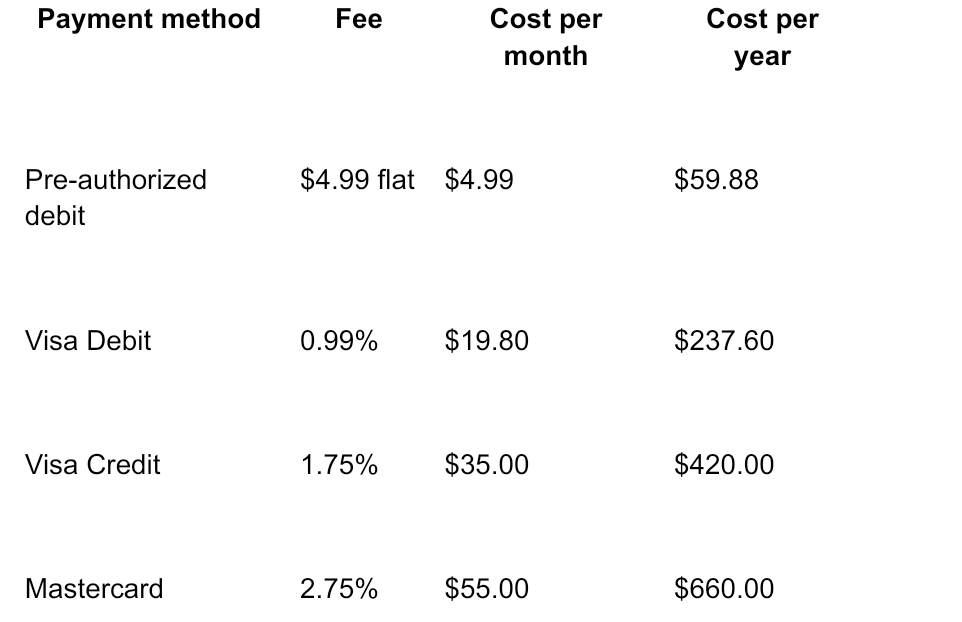
TenantPay publishes its tenant fees per payment: starting from $4.99 for pre-authorized debit (PAD), 0.99% for Visa Debit, 1.75% for Visa Credit and 2.75% for Mastercard. Creating an account is free, there are no setup fees, annual fees or hidden charges, and renters can choose a different method each month. Its pricing page adds that Visa Debit at 0.99% is the cheapest option after PAD. Applied to $2,000 of monthly rent, the fees work out as follows.
What Do You Get Back for the Fee?
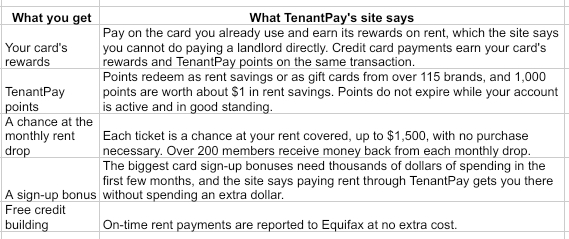
TenantPay's site lists five things that offset the fee.
 .
.
TenantPay's help centre says many members earn back more than the fee in points alone, and its pricing page states that you still come out ahead. Those are TenantPay's own estimates, so check them against your own card
How Do You Test It With Your Own Numbers?
Add up four items for a month: your card's reward rate times your rent, the value of your points (1,000 points is about $1 in rent savings), any sign-up bonus spread over the months you will pay this way, and what a rent drop ticket and credit reporting are worth to you. Then subtract the fee. In the example above, a 2% card on $2,000 of rent returns $40 against a $35 Visa Credit fee, so the card rewards alone cover the fee by $5 before points, tickets and credit reporting are added.
TenantPay's rewards calculator does this for you. You choose your rent and how you will pay, and it shows your card rewards, TenantPay points and drop tickets before you sign up. Its estimates assume a typical set of reward-earning activities, including paying on time, paying at least 14 days early, using autopay, reporting your rent and up to 10 referrals, so actual rewards may be higher or lower. The "up to 6.00%" return on rent on its homepage is an upper estimate on the same assumptions.
What Else Counts Beyond the Fee?
Whether You Pay the Balance in Full
A card reward is worth nothing if interest takes it back. The Financial Consumer Agency of Canada lists carrying a balance, how much debt you owe and being close to or over your credit limit among the habits that affect your credit score, in its credit report and score basics. Its example is a $5,000 limit with $4,500 owing, which lenders may see as higher risk than someone who owes $1,000. A $2,000 rent payment is a large share of many card limits, so pay it off before the statement date if you can.
Which Payment Method Fits You
Choose PAD for the lowest cost, with a fee that starts at $4.99, or Visa Debit at 0.99% if you prefer a percentage. Choose Visa Credit at 1.75% or Mastercard at 2.75% if you want your card's rewards and TenantPay points on the same payment, or if a card's welcome offer is in play. You can switch methods each month, with no contract.
Final Thoughts
Paying rent by card is a calculation, not a rule. Start with the fee percentage, then add up what the platform gives back: your card's rewards, points, rent drop tickets and credit reporting. If the total beats the fee for your card and your habits, you gain rewards on your largest bill, and TenantPay's calculator and help centre say many members do. The calculation takes a few minutes, so run it before you decide. Then check the one thing that can undo it, which is whether you will pay the card in full every month. Revisit the math whenever your rent, your card or the fees change, because a small shift in any of them moves the answer. This is general information, not financial advice, so use your own figures.
Frequently Asked Questions
Can you pay rent by credit card in Canada?
Yes, through a payment platform. TenantPay accepts Visa Credit and Mastercard, delivers the funds to your landlord's bank account by direct deposit in your name within 1 to 3 business days, and needs no landlord participation.
Is there a fee to pay rent by credit card?
Yes. TenantPay's fees are 1.75% for Visa Credit and 2.75% for Mastercard, charged on each payment. Creating an account is free.
Does paying rent by card build credit?
The card account builds credit when you pay it on time. Rent reporting is separate: TenantPay reports every on-time rent payment to Equifax at no extra cost.
Do TenantPay points expire?
No. They accumulate while your account is active and in good standing.
Can I switch payment methods?
Yes. Choose a different method each month, with no contracts and no cancellation fees.