
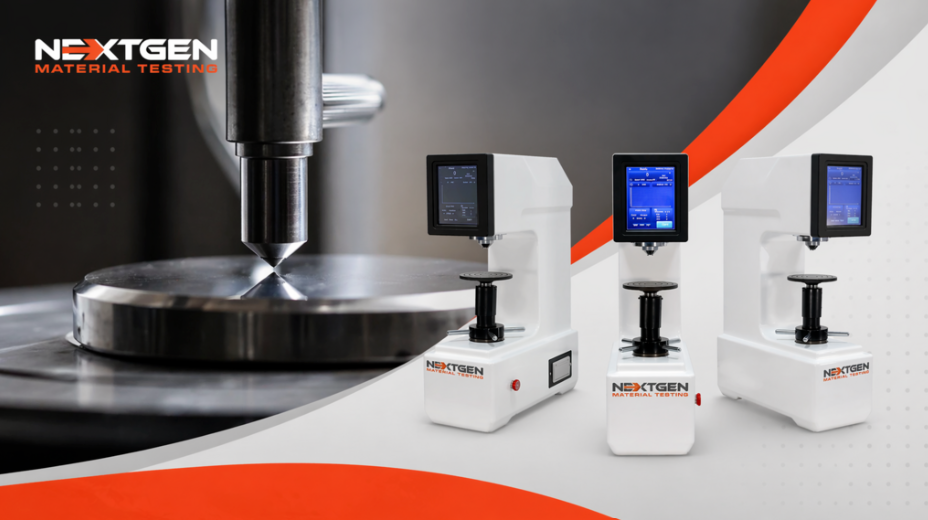
Daily quality control often depends on fast decisions. A lab or production team may need to check whether a batch matches recent results, whether the hardness after heat treatment stayed within the expected range, or whether a material change has started to affect performance. In that kind of work, hardness testing is often one of the quickest ways to spot a shift before it shows up in a larger failure or a longer mechanical test.
Rockwell hardness testing remains a common choice in those routines for a simple reason: it can give a useful answer with limited test time and a straightforward workflow. Still, that does not make it the right method in every situation. Its value depends on the material, the section thickness, the scale being used, and the kind of quality decision the test is meant to support. In daily QC, the more useful question is where Rockwell adds the most value.
Why Rockwell Testing Fits Daily Shop-Floor Control
In daily shop-floor control, speed often matters as much as precision. A quality team may need to check incoming material, review a production batch, or confirm that a heat-treated part still falls within an expected hardness range. In those situations, the method remains widely used because it gives a clear reading in a short test cycle and fits well into repeated inspection work.
That is one reason Rockwell remains common in production environments. When the same types of metallic parts move through the same workflow every day, teams often need a hardness method that is quick to run and easy to read without adding unnecessary delay to inspection. In that context, Rockwell testing is commonly used in routine production control across metalworking and general quality workflows.
The method also works well for quick pass/fail decisions on metallic parts when the goal is to catch a shift early rather than build a full laboratory profile. That may include incoming checks on steel components, batch consistency review after machining or heat treatment, or routine verification that a process is still producing parts within a familiar hardness window. In that kind of workflow, Rockwell is often enough to flag whether the process is staying within its expected hardness range.
When Rockwell Is The Right Choice And When It Is Not
Rockwell testing often makes the most sense when the job is straightforward: a team needs a fast hardness check on a metallic part, and the result needs to support a clear production or quality decision. That is one reason the method is widely used for hardened steels, routine incoming inspection, and follow-up checks after heat treatment. In those settings, a Rockwell reading can quickly show whether a part remains within an expected hardness range without turning a routine QC step into a longer lab exercise.
The standard version is usually a good fit when the material section is thick enough, the surface condition is suitable for the selected scale, and the goal is to evaluate the part as a bulk metallic component rather than study a very small feature. For many production teams, that level of information is enough to judge whether a part or batch still matches the process target. ASTM E18 and ISO 6508 both frame Rockwell as a standardized hardness method for metallic materials, while NIST describes it as a common tool for process control, quality control, and acceptance testing.
The superficial version becomes more useful when the part is thinner or when the surface layer is too limited for a regular setup. ASTM A370 notes that the superficial Rockwell is used for very thin steel or thin surface layers, using lower total test forces than standard Rockwell. That makes it a better fit for parts that may be too thin for a regular Rockwell setup.
Other hardness methods are often more informative when the inspection question is more localized. Thin sections, coatings, shallow hardened cases, and hardness gradients usually call for Vickers or Knoop rather than standard Rockwell. ASTM E384 covers microindentation at much lower forces, which is why Vickers or Knoop are usually better suited to case depth, coatings, and surface gradients.
Part thickness and test purpose matter because hardness methods do not answer every question in the same way. A useful example comes from Buehler, which notes that a steel sheet around 57 HRC needs a thickness of about 0.76 mm for a valid standard HRC test under ASTM E18 conditions; a sheet at about 0.51 mm is too thin for that same setup. In those cases, the testing method needs to match the part geometry and the purpose of the check.
Mistakes That Can Distort A Routine Hardness Check
Misleading hardness results do not always come from a faulty machine. In daily QC, the problem often starts earlier, with scale selection that does not match the material being tested. A hardened steel part, a softer alloy, and a thin section do not always belong on the same scale, and a mismatch at that stage can distort the reading before anyone starts interpreting the result.
Section thickness is another common issue. A part may look suitable for a routine hardness check and still be too thin for the selected setup. Surface condition matters too. If the test area is rough, unstable, or poorly supported, the reading may reflect the setup as much as the material itself. In practical terms, the test works best when the part, the scale, and the support conditions all align with the purpose of the test.
Another mistake is to treat one reading as a full picture of the part or the process. In routine production work, a single hardness point can be useful as a quick signal, but it does not always describe the whole component. Local variation, surface effects, or a small shift in test location can change the result enough to matter. That is why repeated checks and sensible sampling still matter, even in fast QC workflows.
Routine verification is just as important. A hardness method may be fast, but daily use still depends on stable readings, clear readouts, and consistent operator handling. In busy inspection environments, many labs also look at digital Rockwell hardness testers when easier day-to-day operation and readable results are part of the workflow.
A Practical Way To Judge Whether Rockwell Fits The Job
This hardness method remains one of the most useful options for daily quality control when the testing goal is clear and the part suits the method. It works well for routine checks on metallic components, especially when teams need a fast reading to review batch consistency, heat-treatment results, or incoming material condition. In that role, the method is valued for how well it fits everyday production decisions.
Still, method selection depends on more than familiarity. Part thickness, surface condition, scale choice, and the purpose of the check all shape whether a Rockwell result will be useful. When the inspection question involves thin sections, coatings, shallow hardened layers, or localized hardness changes, another method may provide a more meaningful answer.
In daily QC, what matters most is whether the method fits the material, the part geometry, and the decision behind the test. When those factors align, Rockwell can be a reliable choice for routine QC.
Frequently Asked Questions
1. What Is Rockwell Hardness Testing Used For In Daily QC?
This method is often used for fast routine checks on metallic parts. In daily QC, it helps teams review batch consistency, incoming material, heat-treatment results, and acceptance against an expected hardness range without turning every check into a longer lab procedure.
2. When Is Rockwell Better Than Vickers?
It usually makes more sense when the goal is a quick hardness reading on a bulk metallic part in routine production work. Vickers becomes more useful when the inspection question is more localized, such as a small feature, a thin section, or a hardness change across a short distance.
3. What Is Superficial Rockwell Testing?
Superficial Rockwell is a lower-force version of the Rockwell method used for very thin steel or thin surface layers. ASTM A370 describes superficial Rockwell loads of 15, 30, or 45 kgf with a 3 kgf minor load, which helps cover cases where a regular Rockwell setup may be too heavy.
4. Can Rockwell Be Used On Thin Materials?
Sometimes, but not always. Thin material can be a problem if the selected scale and force are too demanding for the section being tested. In those cases, superficial Rockwell may be more suitable, and for very thin areas or surface-focused work, microindentation methods may provide a better answer.
5. Why Does Rockwell Scale Selection Matter?
Scale selection matters because the indenter and force have to match the material and the test purpose. A scale that works for hardened steel may not be appropriate for a softer alloy or a thin section. If that match is wrong, the reading can become misleading before interpretation even begins.
6. Is Rockwell Testing Suitable For Heat-Treated Steel?
Yes, often. The method is widely used for hardened steels and for follow-up checks after heat treatment when the goal is to confirm that parts still fall within an expected hardness range. It is especially useful when the QC decision is straightforward and speed matters.
7. How Often Should A Rockwell Tester Be Verified?
Routine verification matters in daily use, especially when the tester supports production release or acceptance decisions. Standards and reference-material practice treat verification as part of measurement control, not as an optional extra, though the exact schedule depends on the lab's procedure, standard, and workload.