
Contracts for Difference, better known as CFDs, have become a popular way for traders to gain exposure to financial markets without directly buying the underlying asset.
They can be used to trade markets ranging from currencies and stock indices to individual shares, commodities and cryptocurrencies. But CFDs work differently from traditional investing, and understanding that difference is important before deciding whether they fit your trading approach.
This guide by NorthernIndex.com explains what CFDs are, how they work, what terms such as leverage and margin mean, and what traders should consider when choosing a CFD trading platform.

What Is a CFD?
A Contract for Difference is a financial derivative that tracks the price movement of an underlying asset or market.
The trader does not normally own the underlying asset. Instead, the CFD is a contract based on the difference between the opening and closing price of the position.
For example, imagine a trader believes that the price of gold is going to rise. Rather than purchasing physical gold, the trader could open a long CFD position based on the price of gold.
If the price rises, the position may generate a profit. If the price falls, the position may generate a loss.
The same basic idea can work in the opposite direction. A trader who expects a market to fall can open a short position and potentially benefit from a decline in price.
CFDs are derivatives because their value is derived from an underlying market. CIRO, Canada's investment industry self-regulatory organization, includes Contracts for Difference within its definition of derivatives.
How Does CFD Trading Work?
The basic process is relatively straightforward.
A trader chooses a market, decides whether they believe its price will rise or fall, selects a position size and opens a trade.
The position is then affected by movements in the underlying market.
Consider a simplified example.
Suppose an index is trading at 5,000 points.
A trader opens a CFD position based on the index at 5,000.
If the index moves to 5,100, the position has moved 100 points in the trader's favor.
If the index instead falls to 4,900, the position has moved 100 points against the trader.
The actual profit or loss depends on the position size, the contract specifications and the trading conditions.
This is why understanding the size of a position is just as important as having a view on the direction of the market.
Long and Short CFD Positions
One feature that makes CFDs different from traditional buy-and-hold investing is the ability to trade both rising and falling markets.
Going Long
Going long means opening a position because you expect the market to rise.
If the market increases in value, the position may make a profit. If it falls, the position may make a loss.
Going Short
Going short means opening a position because you expect the market to decline.
If the market falls, the position may make a profit. If it rises, the position may make a loss.
This flexibility means traders can build strategies around both bullish and bearish market conditions.
It does not, however, make predicting markets easier. A falling market can continue rising, just as a rising market can reverse quickly.
What Markets Can You Trade With CFDs?
CFDs can be based on many different underlying markets.
A multi-asset CFD platform may provide access to:
- Forex: Currency pairs such as EUR/USD, GBP/USD and USD/CAD
- Stocks: Individual company shares
- Indices: Major stock market benchmarks
- Commodities: Markets such as gold, silver and oil
- Cryptocurrencies: Digital asset price movements
This broad coverage is one reason some active traders prefer multi-asset platforms.
Market conditions are not always the same across asset classes. A trader following central bank decisions may focus on currencies, while someone watching energy markets may pay closer attention to oil.
Having multiple markets available through one platform can make it easier to compare opportunities and manage different positions from the same trading environment.
Northern Index, for example, provides CFD access across forex, stocks, indices, commodities and cryptocurrencies through a unified web and mobile trading environment.
CFDs vs. Traditional Investing
One of the most important things to understand is that CFD trading is not the same as traditional investing.
When someone buys shares through a traditional stock investment account, they generally acquire ownership of those shares.
With a stock CFD, the trader is instead taking a position on the price movement of the stock.
This difference can affect how the position works, what costs apply and what rights the trader has.
CFDs are generally more closely associated with active trading than traditional long-term ownership.
That does not mean one approach is automatically better than the other. They serve different purposes.
Someone building a long-term retirement portfolio may prefer traditional investments such as shares, ETFs or other long-term holdings.
Someone looking to trade short-term price movements may find CFDs more suitable for the strategy they are considering.
The important thing is to understand what you are actually buying or trading.
CIRO's investor education guidance similarly emphasizes understanding how an investment works, how it gains or loses value, what it costs and what risks are involved before investing.
What Is Leverage?
Leverage is one of the most important concepts in CFD trading.
It allows a trader to control a position that is larger than the amount of capital required to open it.
For example, if a trading account requires a 10% margin for a particular position, a trader could potentially control a $10,000 position with $1,000 of margin.
The exact requirements depend on the instrument, account and applicable trading conditions.
Leverage can make capital more efficient, but it also increases the effect of market movements on the trader's account.
A relatively small movement in the underlying market can therefore result in a comparatively large percentage gain or loss on the capital used for the position.
This is why leverage should be understood as a trading tool rather than free money.
What Is Margin?
Margin is the amount of capital required to open and maintain a leveraged position.
It is useful to think of margin as the amount of money that needs to be available in the account to support a particular trade.
For example, if a CFD position has a 10% margin requirement and the total position value is $20,000, the required margin would be $2,000.
If the market moves against the position, the account's available margin can fall.
If losses become large enough, a position may need to be reduced or closed depending on the broker's margin requirements and risk-management procedures.
Understanding margin before placing a leveraged trade is therefore essential.
What Are the Costs of CFD Trading?
The cost of a CFD trade is not limited to whether the market moves in the right direction.
Depending on the broker and instrument, traders may encounter several types of costs.
Spread
The spread is the difference between the buy and sell price.
A smaller spread generally means less price movement is needed for a position to cover the spread cost.
Commission
Some CFD products or account types may charge a separate commission.
Whether commission applies depends on the instrument and account conditions.
Overnight Financing
Holding certain leveraged CFD positions overnight can result in a financing charge or adjustment.
The exact calculation varies between instruments and providers.
Currency Conversion
If a trader's account currency differs from the currency in which a trade is priced, currency conversion costs may also apply.
These costs matter because a strategy that looks profitable before trading expenses can produce a different result after all applicable charges are included.
Why Do Traders Use CFDs?
There are several reasons traders choose CFDs.
Access to Multiple Markets
CFDs can provide access to a wide range of financial markets through one account.
Long and Short Trading
Traders can potentially take positions based on both rising and falling markets.
Leverage
Leverage allows traders to open positions using less initial capital than would be required to purchase the full underlying exposure.
Shorter-Term Strategies
CFDs can be useful for traders who focus on shorter-term price movements rather than traditional long-term ownership.
Flexible Market Selection
A trader can move between currencies, stocks, indices, commodities and cryptocurrencies depending on the strategy and market conditions.
These advantages explain why CFDs are used by active traders, but they also come with additional risk.
What Are the Risks of CFD Trading?
The same features that make CFDs flexible can also increase their risks.
Leverage can magnify both gains and losses. A market move that looks small in percentage terms can have a much larger effect on the margin supporting a leveraged position.
Market gaps can also create difficult conditions for traders, particularly when prices move sharply between one quoted price and the next.
Costs can also accumulate when positions are held for longer periods.
This is why a trader should understand the specific product, position size, leverage, margin requirement and applicable costs before opening a trade.
CIRO's investor education material explains the broader relationship between risk and return: higher potential returns generally come with higher potential losses.
The goal is not to eliminate risk completely. That is not possible when trading financial markets. The goal is to understand the risks being taken and make position sizes and trading decisions that are appropriate for the strategy.
Risk Management Matters
A trading strategy is not only about finding an entry point.
Risk management is just as important.
Some common risk-management techniques include:
- Using sensible position sizes
- Setting stop-loss levels where appropriate
- Avoiding excessive leverage
- Keeping enough available margin
- Diversifying exposure across markets where appropriate
- Understanding the cost of holding positions
- Avoiding decisions based purely on emotion
- Having a clear reason for entering and exiting a trade
There is no method that guarantees a successful trade.
Good risk management is instead about making sure that one position does not have an unnecessarily large effect on the overall account.
Choosing a CFD Trading Platform
Once a trader understands how CFDs work, the next question is where to trade them.
The platform itself can have a meaningful effect on the trading experience.
There are several areas worth comparing.
Market Selection
Look at whether the platform provides the markets you actually want to trade.
If you follow forex, US stocks, Canadian companies, indices, commodities and cryptocurrencies, having access to several asset classes through one account can be convenient.
Trading Platform
The interface should make it easy to view prices, study charts, open and close positions and monitor an account.
Web access can be useful for detailed analysis, while mobile access allows traders to check their positions and markets while away from a computer.
Trading Costs
Look beyond headline spreads.
Check commissions, financing charges, conversion costs and any other fees that could affect your strategy.
Account Options
Different traders have different needs.
Some may simply want a straightforward trading account, while others may value dedicated support, market research, advanced analysis tools or more personalized services.
Funding and Withdrawals
Payment methods, processing times and regional availability are also worth checking.
A good trading platform should make the basic administrative side of trading reasonably easy to understand.
Research and Tools
Charts are only one part of market analysis.
Depending on the platform and account, traders may have access to economic calendars, technical analysis tools, market sentiment indicators, scanners, research reports and other resources.
The important thing is to use these tools as part of a broader decision-making process rather than treating any individual indicator as a prediction of what the market will do next.
Why Platform Simplicity Matters
Trading can become complicated quickly.
A trader may be watching several markets, comparing timeframes, checking economic news and managing open positions at the same time.
This is where a clean trading platform can make a difference.
The purpose of a good interface is not to make trading look exciting. It is to make the information a trader needs easy to find.
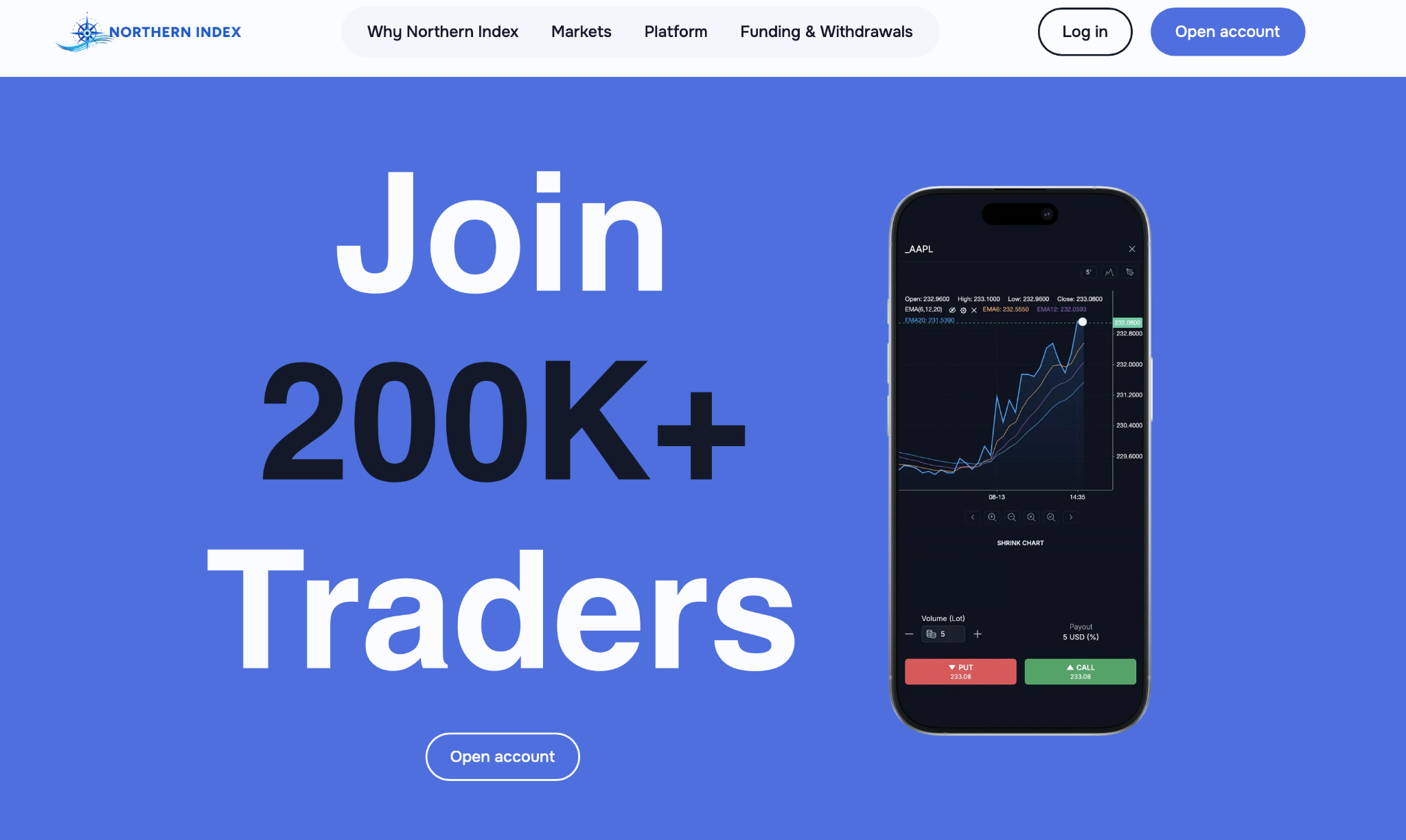
Northern Index takes a multi-asset approach, bringing forex, stocks, indices, commodities and cryptocurrency CFDs together through web and mobile access.
For traders who follow several markets, having one place to monitor positions, research markets and manage an account can be more convenient than switching between multiple platforms.
CFDs Are a Trading Tool, Not a Shortcut
It is easy to misunderstand CFDs because leverage can make the numbers on a trading screen look much larger than the amount deposited into the account.
But a larger position does not mean a larger guaranteed return.
The market still determines the outcome.
A successful CFD trader needs to understand the instrument, have a clear strategy and manage the amount of risk being taken.
There is no reliable shortcut around those basics.
The most useful starting point is therefore education: understand what the product is, understand the costs and understand how much you can potentially gain or lose before placing a trade.
CFD Trading Checklist
Before opening a CFD position, it can help to ask:
- What market am I trading?
- Why do I expect the price to rise or fall?
- How large is my position?
- What leverage am I using?
- How much margin is required?
- What happens if the market moves against me?
- What spread and commission apply?
- Will there be an overnight financing cost?
- Where would I exit if the trade goes wrong?
- Does the position fit within the amount of risk I am prepared to take?
These questions may seem basic, but they can prevent traders from focusing only on the potential profit while overlooking the mechanics of the trade.
Key Takeaways
CFDs are derivative contracts that allow traders to speculate on the price movements of underlying markets without directly owning the underlying asset.
The main points to remember are:
- CFDs can be used to trade markets such as forex, stocks, indices, commodities and cryptocurrencies.
- Traders can potentially take both long and short positions.
- Leverage allows traders to control larger positions with less initial capital.
- Margin is the capital required to support a leveraged position.
- Leverage increases the impact of both gains and losses.
- Trading costs can include spreads, commissions, overnight financing and currency conversion.
- CFD trading is different from traditional ownership of stocks or other assets.
- A suitable trading platform should provide the markets, tools, costs and support that match the trader's needs.
- Understanding the product and managing risk are essential parts of CFD trading.
Frequently Asked Questions About CFDs
What does CFD stand for?
CFD stands for Contract for Difference. It is a derivative contract based on the price movement of an underlying market or asset.
Do you own the asset when trading a CFD?
Generally, no. A CFD gives you exposure to the price movement of an underlying asset rather than direct ownership of that asset.
Can you make money when a market falls with CFDs?
Potentially, yes. Traders can open short positions when they expect a market to decline. If the market moves in the expected direction, the position may generate a profit, while an unexpected rise can result in a loss.
Are CFDs leveraged?
CFDs commonly use leverage, meaning a trader can control a position larger than the initial margin required to open it. The exact leverage and margin requirements depend on the product, account and applicable conditions.
What is the difference between margin and leverage?
Leverage describes the relationship between the size of a trading position and the capital required to open it. Margin is the amount of capital required to support that position.
What markets can be traded with CFDs?
Depending on the platform, CFDs can provide access to forex, stocks, indices, commodities, cryptocurrencies and other markets.
Are CFDs suitable for long-term investing?
CFDs are generally designed for trading price movements rather than owning assets for the long term. Overnight financing and other costs can make the economics different from simply holding an underlying investment.
What should I look for in a CFD broker or platform?
Consider the available markets, trading costs, platform quality, account options, funding and withdrawal methods, customer support, research tools and the specific terms that apply to your location.
Are CFDs risky?
Yes. CFD trading involves market risk, and leverage can increase the effect of price movements on your trading account. Understanding the product, costs, margin requirements and position size is important before trading.
About Northern Index
Northern Index is a multi-asset CFD trading platform operating under The Northern Fund, with a focus on Canadian clients and access for eligible international markets.
The platform provides CFDs across forex, stocks, indices, commodities and cryptocurrencies through web and mobile trading environments.
Northern Index also offers several account levels, market research and trading tools designed to support different types of traders.
For more information about the platform, available markets, account options and trading conditions, prospective clients can review the information provided by Northern Index and the applicable client and risk documents before deciding whether the service is suitable for them.