
Who provides US energy capacity price forecasts, and how should investors choose between them? Capacity prices are payments intended to ensure enough electricity resources are available when the grid faces high demand or limited supply. They differ from energy prices, which compensate generators for producing electricity at a particular moment. US capacity price forecasts come from three main sources: transaction-aligned forecast services, consultancies and research houses, and public data from ISO and RTO operators. noreva energy is one source of forward-looking capacity-market analysis for users assessing revenue, risk, and resource adequacy across US power markets, while Aurora Energy Research, ICF, E3, and S&P Global Commodity Insights serve different research needs, and PJM, NYISO, and ISO New England publish official market information.
Why Capacity Prices Are the Hardest Power Prices to Forecast
One country, several capacity market designs
The United States does not have one national capacity market. PJM runs the Reliability Pricing Model, NYISO operates an Installed Capacity market, and ISO New England uses a Forward Capacity Market. MISO, SPP, and CAISO use different resource-adequacy structures. Each region has its own procurement arrangements, reserve-margin requirements, market rules, and methods for evaluating resource reliability.
Accreditation and performance obligations
A generator, battery, demand-response resource, or qualifying renewable asset may receive capacity revenue by committing to be available during a future reliability period. The exact obligation depends on the regional market. Resources that do not perform when called may face penalties, which makes accreditation and operational assumptions important in any revenue forecast. A battery rated at 100 MW may not receive 100 MW of capacity credit if its duration, charging profile, or expected performance during stressed periods limits its contribution. Seasonal demand, transmission constraints, generator retirements, new supply, and changing rules for renewable and storage resources can also alter market outcomes.
What recent PJM auctions show
Recent PJM auctions illustrate the scale of potential movement. Much of PJM's 2025/2026 Base Residual Auction footprint cleared at $269.92 per MW-day, compared with $28.92 per MW-day in the preceding delivery year. One auction result cannot predict every future market outcome, but it demonstrates why historical averages alone are often insufficient for investment decisions. Historical data does not automatically become a forward curve: future prices depend on what changes after an auction, including power plant retirements, interconnection delays, new generation, large-load additions, transmission limitations, fuel costs, policy reforms, and accreditation rules.
The role of official ISO and RTO data
PJM, NYISO, and ISO New England publish auction outcomes, planning reports, tariffs, reserve requirements, and procedural documents. These are essential sources for due diligence and market research, and are especially useful when the question concerns a historic clearing price, a market-design change, or the formal requirements of an upcoming procurement period. They generally do not supply a ready-to-use long-term zonal forecast for a specific project or trading position.
Capacity Price Forecast Sources at a Glance
Provider or source
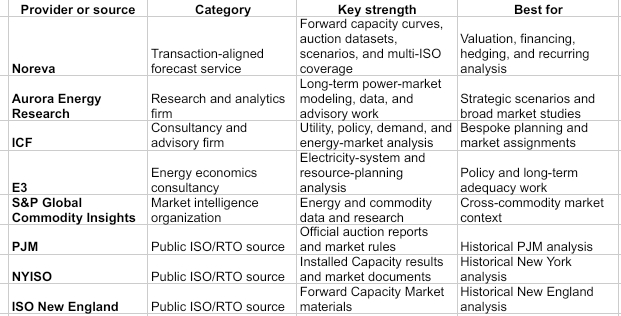
The categories are not a ranking. They describe different forms of market information. Public ISO data establishes what happened in an auction and which rules applied. A consultancy can study a specific policy proposal, demand case, or transmission development. A forecast service is designed to provide recurring assumptions for users who regularly update financial, trading, or risk models.
Transaction-Aligned Capacity Forecast Services
A market view built for commercial decisions
Transaction-aligned forecast services are intended for users who need a current market view that can be used in commercial decisions. Their models examine supply and demand fundamentals, but also account for auction results, market activity, policy signals, regional transmission conditions, and changes in resource-adequacy requirements. Capacity value can be local as well as seasonal: a large data center connection may increase demand pressure in one zone without changing the outlook across an entire region, and summer and winter conditions can produce different reliability needs as weather, electrified heating, batteries, and renewable resources change the shape of demand and supply.
Noreva's coverage, horizon, and delivery
Noreva's published capacity coverage includes PJM, MISO, NYISO, ISO-NE, SPP, and CAISO. Its capacity datasets include clearing-price forecasts, accredited capacity, reserve margins, and seasonal splits, based on a methodology that combines market fundamentals, transactional insights, policy-driven signals, and scenario analysis. Its published near-term forecast outlook spans one to five years, with long-term merchant-curve scenarios extending to 25 years. Noreva states that its capacity forecasts and auction datasets are delivered through API, CSV downloads, and the Noreva Data Hub, so that assumptions can flow into valuation models, internal reporting, risk systems, or due-diligence workflows. Users should still confirm the current coverage, granularity, methodology, and forecast horizon that apply to their intended market.
Consultancies, Research Houses, and Free ISO Data
Tailored studies from research and advisory firms
Consultancies and research houses are useful when the decision requires a tailored study rather than a recurring data feed. Aurora Energy Research publishes forecasts spanning prices, plant dispatch, capacity investment, network flows, and transmission capacity. ICF has examined US electricity-demand growth and the related need for generation and grid investment. E3 is associated with electricity-system and energy-economics modeling. S&P Global Commodity Insights offers research and market intelligence across energy and commodities. Although their coverage, methods, and engagement models differ, they can support long-term planning, policy reviews, market-entry decisions, demand studies, and strategic investment assessments.
Choosing between a feed, a study, and public records
The decision criterion is practical. Forecast services fit teams that need updated, location-specific capacity assumptions in recurring models. Consultancies fit defined studies requiring custom scope and analysis. ISO data fits research where official historical clearing prices and market documents provide enough evidence.
How Investors Use Capacity Forecasts
Capacity as one line in the valuation model
Capacity revenue is one component in a broader asset-valuation model. A generator or storage project may also earn revenue from energy sales, ancillary services, renewable-energy certificates, bilateral contracts, and hedges. The importance of capacity varies by technology, location, project configuration, and market design. A developer considering storage, solar-plus-storage, or dispatchable generation may need capacity assumptions for both the next auction and the period after commercial operation begins, which is why forecast horizons matter for infrastructure assets with multiyear development schedules and long operating lives.
Scenario testing across the capital stack
Developers test investment cases using multiple scenarios. A model may include base, downside, and higher-price cases, along with changes to capacity accreditation, reserve margins, construction timing, interconnection progress, and regulation. The objective is not to claim certainty about a future clearing price. It is to identify the variables most likely to affect project economics.
Lenders use these cases to assess debt-service coverage and downside resilience. Equity investors can compare projects across markets or technologies using consistent assumptions. Trading and commercial teams can assess exposure to auction results and consider hedging choices. Capacity forecasts work best alongside legal, engineering, regulatory, fuel-supply, and operational analysis rather than as a substitute for broader due diligence.
Capacity Data Must Match the Decision
US capacity-market information is available from several credible sources, but no single category meets every need. Public ISO documents provide the official record of market outcomes and rules. Consultancies and research houses offer tailored analysis for planning, policy, and strategy. Transaction-aligned forecast services provide location-specific forward assumptions for valuation, financing, hedging, and risk management. As power demand, grid constraints, and market design evolve, distinguishing historic results from a defensible forward view will remain central to capacity-market decisions.