

HubSpot currently trades at $234.56 per share and has shown little upside over the past six months, posting a middling return of 2%. The stock also fell short of the S&P 500’s 7.7% gain during that period.
Is now the time to buy HUBS? Or does the price properly account for its business quality and fundamentals? Find out in our full research report, it’s free.
Why Does HUBS Stock Spark Debate?
Born from the idea that traditional interruptive marketing was becoming less effective, HubSpot (NYSE:HUBS) provides an integrated platform that helps businesses attract, engage, and manage customer relationships through marketing, sales, service, and content management tools.
Two Positive Attributes:
1. ARR Surges as Recurring Revenue Flows In
While reported revenue for a software company can include low-margin items like implementation fees, annual recurring revenue (ARR) is a sum of the next 12 months of contracted revenue purely from software subscriptions, or the high-margin, predictable revenue streams that make SaaS businesses so valuable.
HubSpot’s ARR punched in at $3.58 billion in Q2, and over the last four quarters, its year-on-year growth averaged 21.3%. This performance was impressive and shows that customers are willing to take multi-year bets on the company’s technology. Its growth also makes HubSpot a more predictable business, a tailwind for its valuation as investors typically prefer businesses with recurring revenue. 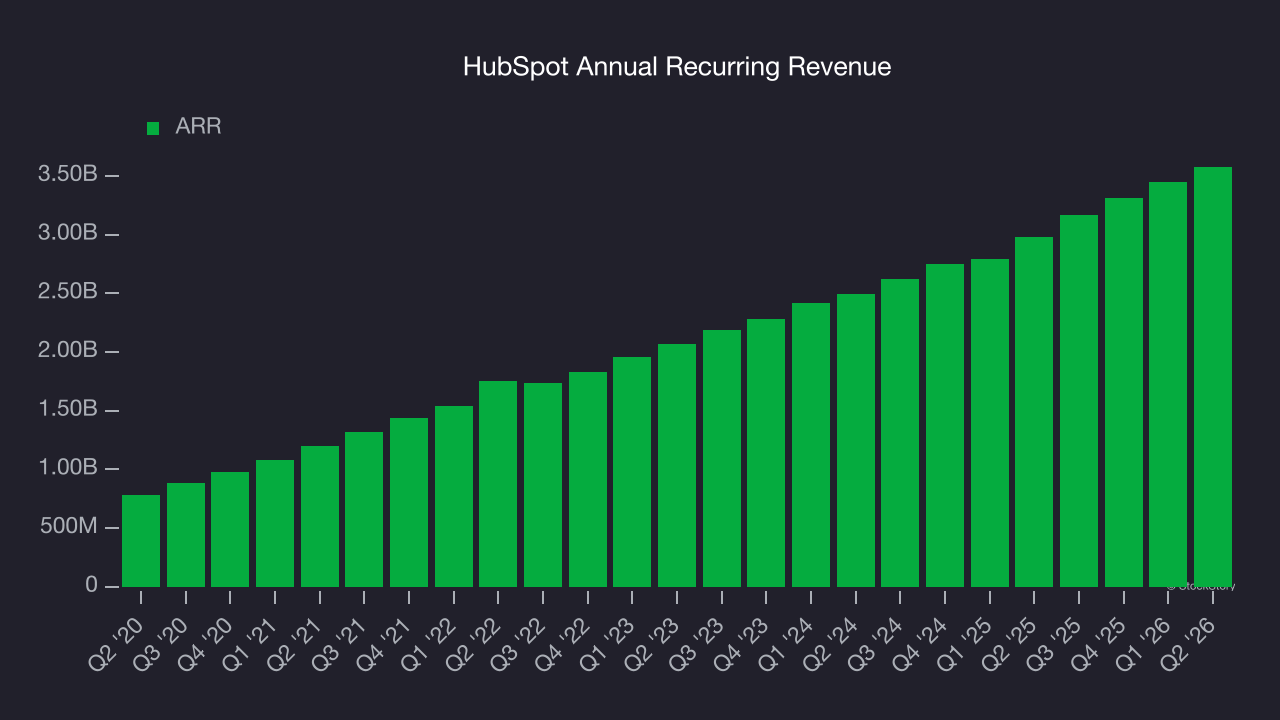
2. Elite Gross Margin Powers Best-In-Class Business Model
Software is eating the world. It’s one of our favorite business models because once you develop the product, it usually doesn’t cost much to provide it as an ongoing service. These minimal costs can include servers, licenses, and certain personnel.
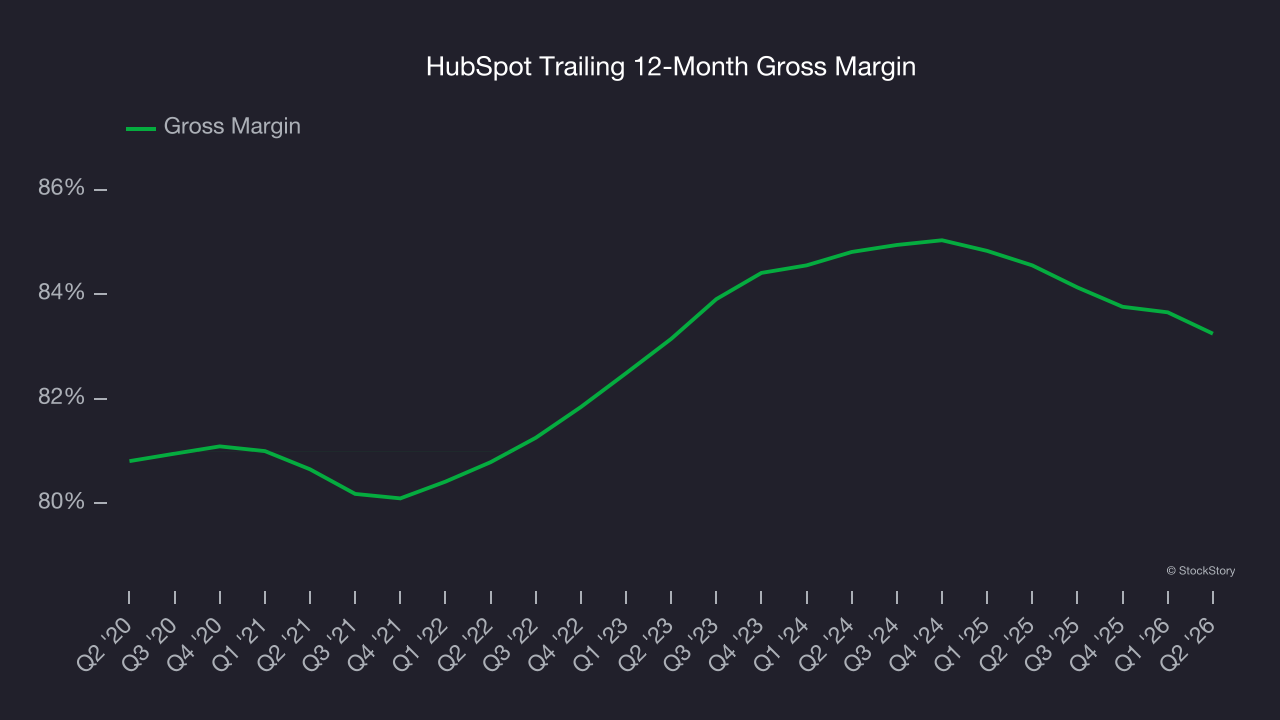
HubSpot’s gross margin is one of the highest in the software sector, an output of its asset-lite business model and strong pricing power. It also enables the company to fund large investments in new products and sales during periods of rapid growth to achieve outsized profits at scale. As you can see below, it averaged an elite 83.2% gross margin over the last year. That means HubSpot only paid its providers $16.75 for every $100 in revenue.
The market not only cares about gross margin levels but also how they change over time because expansion creates firepower for profitability and free cash generation. HubSpot has seen gross margins decline by 1.6 percentage points over the last 2 years, which is poor compared to software peers.
One Reason to Be Careful:
Operating Margin Rising, Profits Up
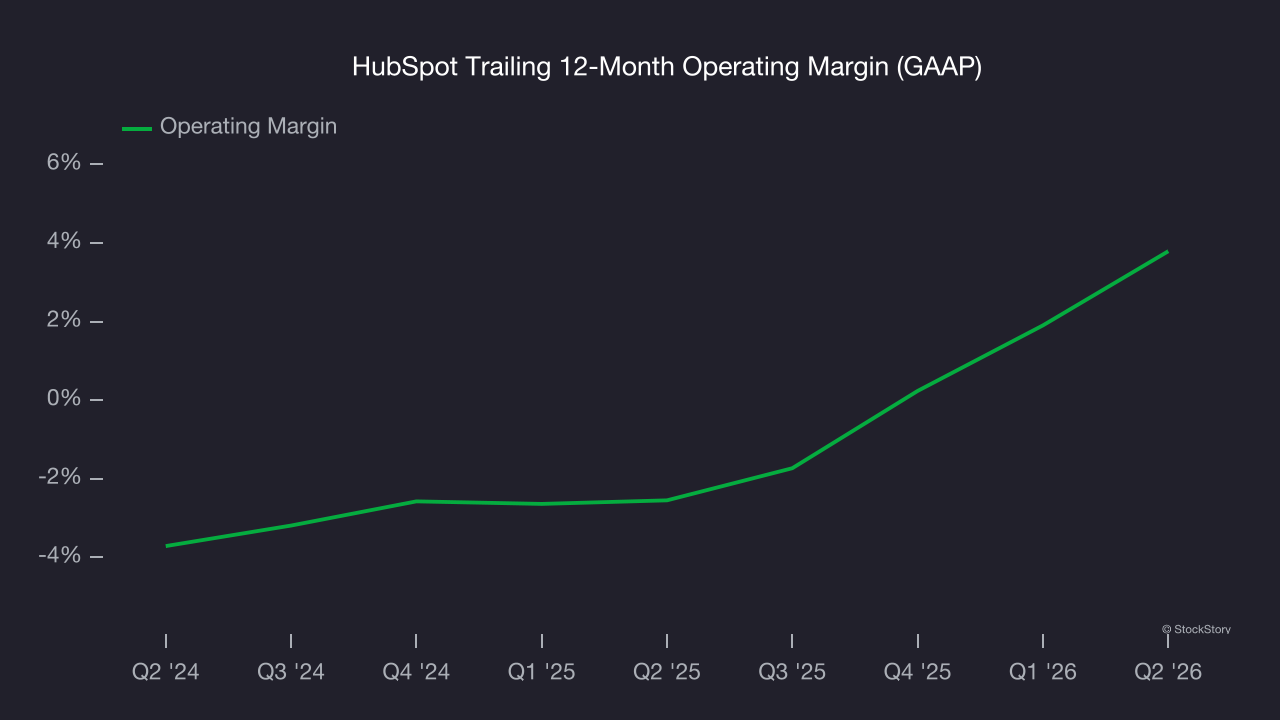
Many software businesses adjust their profits for stock-based compensation (SBC), but we prioritize GAAP operating margin because SBC is a real expense used to attract and retain engineering and sales talent. This is one of the best measures of profitability because it shows how much money a company takes home after developing, marketing, and selling its products.
Analyzing the trend in its profitability, HubSpot’s operating margin rose by 6.3 percentage points over the last two years, as its sales growth gave it operating leverage. Its operating margin for the trailing 12 months was 3.8%.
Final Judgment
HubSpot has huge potential even though it has some open questions. With its shares lagging the market recently, the stock trades at 3× forward price-to-sales (or $234.56 per share). Is now a good time to initiate a position? See for yourself in our full research report, it’s free.
Stocks We Like Even More Than HubSpot
ONE MORE THING: Top 6 Stocks for This Week. This market is separating quality stocks from expensive ones fast. AI is taking down whole sectors with no warning. In a rotation this fast, you need more than a list of good companies.
Our AI system flagged Palantir before it ran 1,662% between October 2022 and February 2026. AppLovin before it ran 753% between February 2024 and February 2026. Nvidia before it ran 1,178% between January 2023 and February 2026. Each week it produces 6 new names that pass the same tests. Get Our Top 6 Stocks for Free HERE.
Stocks that have made our list include now familiar names such as Nvidia (+1,460% between June 2020 and June 2025) as well as under-the-radar businesses like the once-small-cap company Comfort Systems (+1,154% between June 2020 and June 2025). Find your next big winner with StockStory today.